No Safe Harbor: Martin R. Delany's Figurative Emigrations
In May 2025, The New York Times interviewed Yale University professors Marci Shore, Timothy Snyder, and Jason Stanley under the headline, “We Study Fascism, and We’re Leaving the U.S.” Although Shore, Snyder, and Stanley never use the word “fascism” directly in describing contemporary America, their message was clear: the United States is sliding toward authoritarianism, and they are emigrating in political protest. Shore, a historian of totalitarianism, explained her decision by invoking the lessons of 1930s Europe: “The lesson of 1933 is you get out sooner rather than later.” For these scholars, emigration represents a viable method for imagining their continued survival in an increasingly hostile political environment. Unsurprisingly, the interview prompted an overwhelming response, perhaps best summarized by this Reddit comment: “Yeah a lot of us agree we are turning fascist, but we don’t have spare income to just pack up and move countries.”
The Reddit commenter, among others, articulated one of the central tensions that looms over past and present emigrationist efforts: not just whether to stay or go, but who gets to make that choice at all. The Yale professors’ decision throws into sharp relief the class dimensions of political exile. While they possess the financial resources, professional mobility, and passport privileges to make international relocation feasible, the vast majority of Americans, particularly those most vulnerable to state violence, do not have such options.
At the very moment these professors choose to leave, millions of immigrants are fighting to stay. Immigrants face violent detention by ICE agents, deprivation of their rights, and the lurking, constant threat of deportation from the very country Shore, Snyder, and Stanley are fleeing. Shore herself acknowledges this tension in the interview, describing how she imagined what she would do “if guys in masks tried to grab my student.” She confesses, “Maybe I would get scared and run away. The truth is, I don’t know. Not knowing terrified me.” This paradox raises urgent questions: Is expatriation really a form of activism when it remains accessible only to the privileged? What does it mean to frame leaving as resistance when so many are being violently expelled?
As I turned this exchange over in my head, I kept circling back to what felt absent from the professors’ analysis. Shore, Snyder, and Stanley looked to 1930s Germany and Russia for models of authoritarian resistance. Yet, these historical models are external to the United States, as if American soil hasn’t generated its own rich traditions of survival under conditions of state terror. For over two centuries, Black thinkers and activists have grappled with a question the Yale professors are only now confronting: How do you survive and resist in a nation-state that treats your very existence as dispensable and disposable? One need not look outside the United States for models of oppression and resistance. Instead, strategies for surviving fascist conditions have been developed and refined by Black people for centuries on this very land. The abolitionist Martin R. Delany knew something about emigration as a means for survival.
In response to the Mexican-American War and, specifically, the Fugitive Slave Act of 1850, Delany urged the “formation of a black emigrationist society.” He argued that the brutal violence and systemic terror of chattel slavery provided sufficient rationale for emigration as “absolutely necessary [for] political elevation.”
To understand why Delany forwarded this argument for emigration, we need to grasp what the Fugitive Slave Act changed. The law didn’t just threaten those who had escaped bondage. It criminalized Black freedom itself. Free Black people in Northern states could be captured, denied jury trials, and sold into slavery based on nothing more than a white person’s testimony. The law turned every white citizen into a potential slave catcher, imposing fines and imprisonment on anyone who aided escapees. It made the entire nation more complicit in slavery’s violence and proved that there was no free soil in America, no geographic spaces where Black people could live safely under the law.
For Delany, the Fugitive Slave Act wasn’t merely a policy; it was definitive proof that the United States would never recognize Black citizenship or protect Black life. In Delany’s vision, a Black emigrationist society would be more than an escape route. It represented a collective refusal to participate in a social contract that never included Black people as human beings. Emigration, then, wasn’t surrender; it was the resistance to a nation that had systematically denied their humanity.
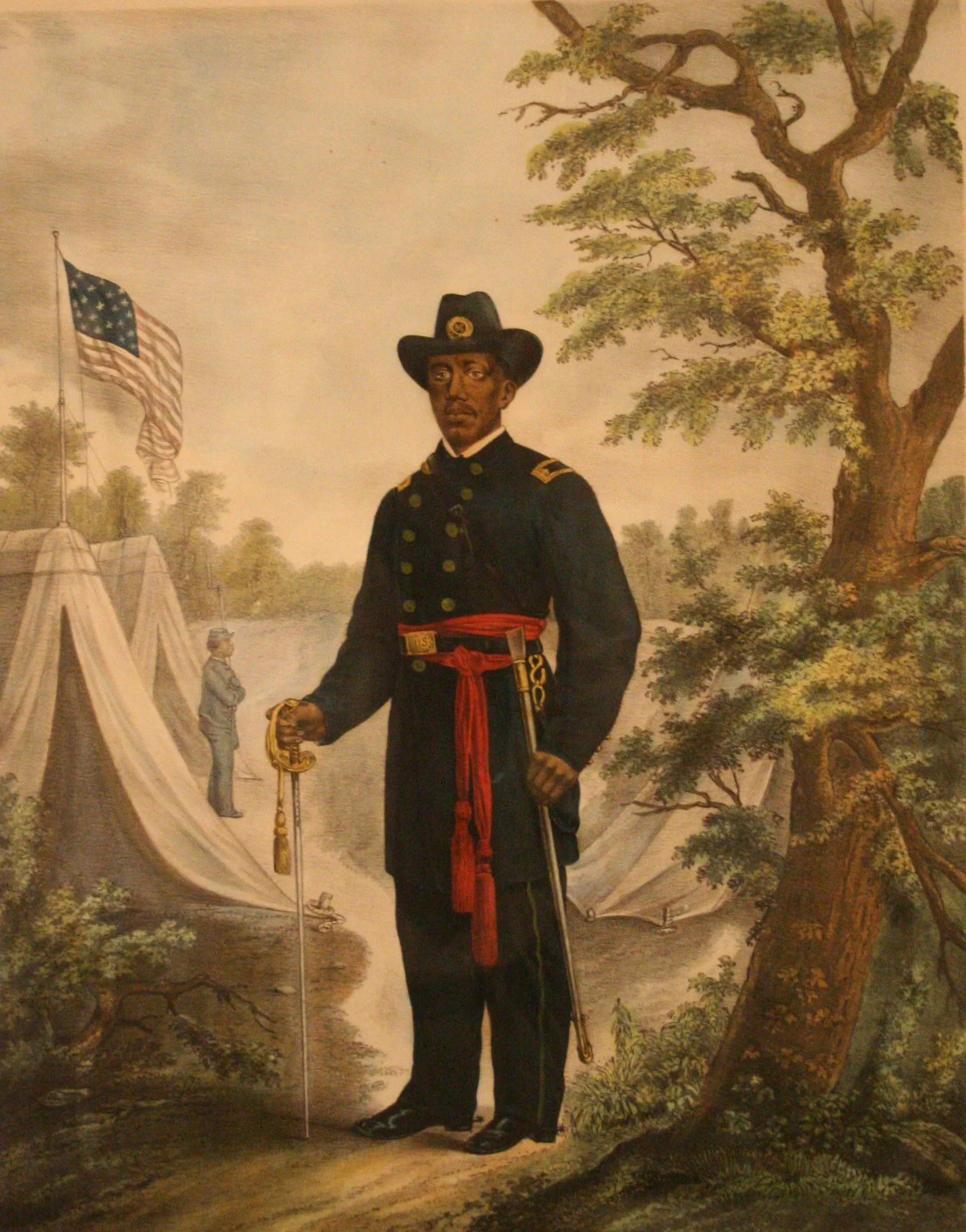
Delany spent the 1850s advocating for, coordinating, and financially backing emigrationist efforts. Delany even moved to Canada to explore establishing settlements in the Caribbean and West Africa. Yet his political journey was conflicted and contradictory. By the 1860s, Delany abandoned his emigrationist project to serve in the 54th Massachusetts Volunteer Infantry Regiment during the American Civil War. As Delany’s political shift implies, even the most committed emigrationists recognized that the question of “staying or going” is never simple.
Before Delany’s later anti-emigrationist turn, he produced one of the most sophisticated literary explorations of emigrationist politics in American literature, Blake; or, the Huts of America. Adam Syvertsen’s recent article “I’ll Wait No Longer” offers critical insights into Delany’s emigrationist thought and captures its relevance in the contemporary moment. Specifically, Syvertsen forwards the term “figurative emigration” to emphasize how the act of “changing places,” whether real or imaginative, becomes an occasion to consider “how places may be changed.” “Figurative emigration” in practice suggests that imagining and enacting new ways of living and organizing society is a more politically efficacious task than moving. In other words, the prospect of escape allows each of us to articulate concrete social and political demands.
While Delany wrote numerous political tracts and treatises throughout his career, it was Blake, a work of serial fiction, that became the fullest expression of his emigrationist politics. Why fiction? Fiction makes claims about what is and what should be but also creates imaginative spaces in which readers can experience alternative social arrangements and feel what liberation might look like.
Henry Blake, the serial’s protagonist, is an enslaved man whose wife is sold to an American slaveowner in Cuba. Rather than accept this violence, Blake escapes and embarks on a deliberate, organized journey through the American South, Canada, and Cuba. Henry does not simply flee. Instead, he coordinates a slave insurrection. Blake traverses national and international spaces, encounters, and advocates for different forms of social and political organization that exist outside of U.S. slavery and imperialism.
Upon Henry’s arrival in New Orleans, Delany notes that “it was on [Mardi Gras] account that the negroes had been allowed such unlimited privileges this evening.” Enslaved people participated in activities that would on any other day be violently suppressed, such as moving freely through the streets, wearing masks to obscure their identities and social positions, speaking openly, and gathering in large numbers. New Orleans’ white power structures tolerated this because eventually order would be restored. Delany seized on this temporary suspension of the city’s controls to imagine an emancipatory uprising. The “unlimited privileges” of Carnival create a brief window in which rebellion becomes thinkable. Enslaved people can envision themselves as agents of history, but Delany is clear-eyed about Carnival’s limitations. Carnival is always contained and designed to end, offering a fleeting glimpse of freedom.
Also, in Blake, Delany points to maroon communities as evidence that another nation isn’t just theoretically possible but already exists. Maroon communities represented a more sustained form of figurative emigration. Throughout the Caribbean and Americas, maroon communities generally formed when enslaved people escaped and established independent settlements in spaces difficult for colonial powers to access.
The Great Dismal Swamp, straddling Virginia and North Carolina, housed one of the largest maroon communities in North America. The communities constituting the Great Dismal Swamp were not only hiding places or temporary refuges; they were an experiment in self-governance that persisted for decades. Maroon communities grew food, traded with one another and sometimes with rural white and Indigenous peoples, developed their own cultural practices, and, when necessary, defended their territories. The maroons demonstrate that survival doesn’t necessarily require seeking refuge in some distant nation but requires creating spaces, even temporary and marginal ones, where alternative social and economic practices, and communal ways of living can take root and flourish.
Delany’s critical insight is that conditions in the United States were simply untenable for survival and required the prospect of somewhere else. This “somewhere else” does not need to be a distant nation. “Somewhere else” can be Carnival or the maroon community, any space where life and survival are possible. Before transforming material conditions, you must be able to imagine that transformation. In this sense, fiction becomes a training ground for emancipatory consciousness.
This brings us back to the Yale professors and their decision to leave. Delany’s Blake presents a distinct challenge to their approach. While I understand Shore, Snyder, and Stanley’s impulse, the harsh reality is that literal emigration offers only a temporary respite. I understand why emigration continues to carry political weight. It is, at base, a method for imagining survival against the backdrop of an environment hostile to that very survival. The impulse to leave is rational and sensible when your immediate circumstances provide neither space, time, nor security to engage in imaginative effort toward change. But no safe harbor remains untouched by these political currents. We should ask how we can transform our present spaces into something survivable. In a radical way, Delany’s Blake suggests that we need both the imagination of elsewhere and the commitment to here.
Recommended Readings:
Ruth Wilson Gilmore, “Abolition Geography and the Problem of Innocence,” in Futures of Black Radicalism
Martin R. Delany, The Condition, Elevation, Emigration, and Destiny of the Colored People of the United States
J. Brent Morris, Dismal Freedom: A History of the Maroons of the Great Dismal Swamp (University of North Carolina Press, 2022).