“Grammar of Resistance”: Carnival as Political Counter-Narration in Grenada
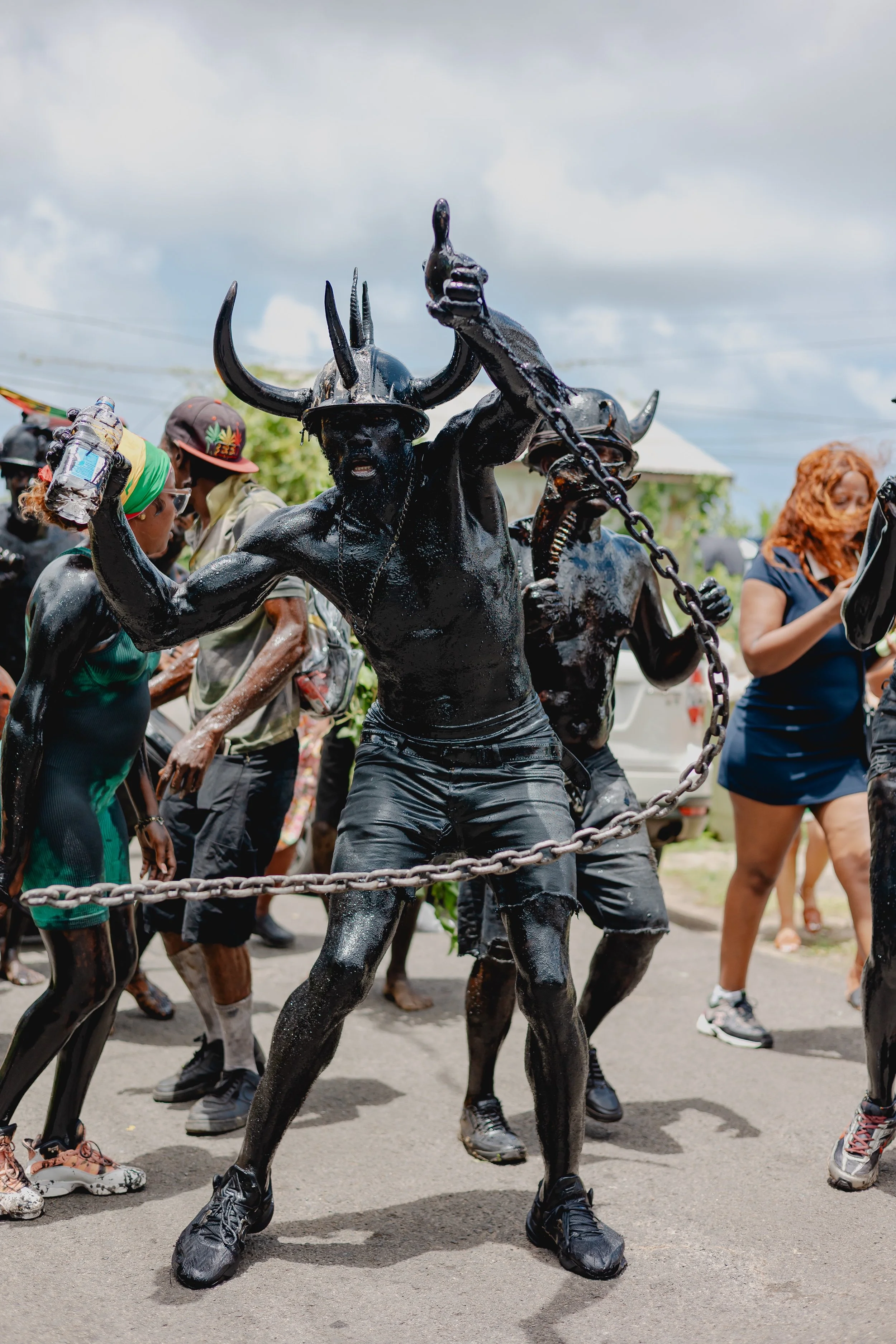
Photograph taken by Querine Salandy for Chambers Media Solutions “A Jaba Jab demonstration in Paraclete, Parish of Saint Andrew, Grenda,” circa 2025.
From Port of Spain, Trinidad and Tobago to Notting Hill, England, carnival celebrations are held throughout the world. While some see carnival as an opportunity for debaucherous revelry, others view it as a time to connect with ancestors or make a subtle political stance. Traditionally, carnival was a pre-Lenten celebration while modern-day carnival has evolved into a year-round event. One of the last carnivals in the calendar year held in the Caribbean is Grenada’s Spicemas, which draws thousands of people from around the world for two days of festivities. The name is a portmanteau of key features of the event’s history. Grenada is called the ‘Island of Spice’ because of its nutmeg production, and ‘Mas’ is a shortened version of masquerade. Carnival, like other African-derived traditions, served to subvert colonial authority but was also a space for social connection. Carnival participants, then and now, connect themselves to the African and Asian diaspora when ‘playing mas.’ They also contribute to a long tradition of political counter-narration.
Grenada’s carnival is unique because of its strong tradition of Masquerade characters. Scholar Tola Dabiri notes, “Grenada is an incredible island for masquerade. Each tiny pocket of a county contains a distinctive form of mas.” Traditional Mas characters tell a story. In Grenada, popular characters include Loup Garou - which, in French, means werewolf, but to Grenadians means a vampire-shapeshifter; Moko Jumbie - a spirit protector who wears long pants or skirts and masks; Wild Indian - a character portraying Arawaks and Kalinago before European colonization; or Vieux Corps - meaning dead body - which is symbolized by those whose presence and dress are serious and silent. Others dress up as ‘the devil’, wearing chains and covering themselves in a blackening agent. Groups, called bands, come together as a unified entity.These characters and bands are not quaint remnants but powerful storytellers. In times when Black history in the region is being written out and distorted, the subversive nature of carnival characters pushes back.
Grenada was inhabited by the Kalinago people until French colonization began in 1649. Despite the fact that the Kalinago people furiously resisted complete French takeover, French settlements grew and the importation of enslaved Africans began as early as 1669. The French ceded Grenada to the British under the 1763 Treaty of Paris, though there was a fleeting French takeover from 1779-1783. In 1784, French inhabitants and their enslaved women, men, and children fled the now-British-Grenada to Trinidad and Tobago carrying their cultural traditions with them. Because of this migration of both European and African-descended communities, Grenada and Trinidad and Tobago’s carnival share many similar characters.
Mas characters and some of the hallmarks of carnival in Grenada, including Pretty Mas and J’ouvert, emerged during the entrenchment of African slavery in the seventeenth century. Because of their connection to satire and resistance, colonial authorities sought to manage such performances. Fédon’s Rebellion (1795-1796), sparked this ruling. The colonial government was afraid of Black gatherings, lest another rebellion occur. Consequently, music and dancing by enslaved people were banned under a 1798 Government Act. Suppression of enslaved music and dancing continued with the 1825 Consolidated Slave Law. Yet as seen in the 1827 St. George’s Chronicle, when white church goers were disturbed by “the drumming and noise of a [Black] dance” on a nearby plantation, the music and dancing by the enslaved persisted.
In the post- emancipation British Caribbean, Charles Day, a white colonial observer of carnival in Trinidad published his observations in Five Years’ Residence in the West Indies. Even though he described this early form of carnival as “squalid splendor” and “very cheap,” many of the quintessential Spicemas figures are detailed. He remarked that some Black participants rubbed black varnish over their “nearly naked” bodies. The group would then place one person in chains and lead them around, occasionally beating the soles of that person’s feet. This action was to simulate and mock enslavement. Day was witnessing “Jab-Jab” – or “Jab Molassie” – in which participants satirically dress up as devils. “Jab-Jab” is acknowledged as having originated in Grenada. “Jab” is derived from the French Creole word for devil. “Jab-Jab” players mock enslavers who would refer to the enslaved as devils. Today in Grenada, “Jab-Jab” players can be seen with horns on their head, chains and padlocks dragging behind them, and live serpents or other creatures around their necks.
Day also observed others covering their heads with white masks which he remarked contrasted with their Black bodies. These celebrants were playing Pierrot Grenade which is a traditional Mas character created in Grenada and still seen today. Pierrot Grenade descends from the Pierrot originating from sixteenth or seventeenth century France. The procession continued with Black women dancing through the streets engaging in Pretty Mas – where participants dress up nicely.
Officials’ uneasiness with carnival did not end with abolition. It continued to be a lightning rod for both political suppression and social agitation. In 1893, Hesketh Bell – a British colonial administrator in Grenada – wrote that during enslavement, Black persons “indulged” in many dances that were “so indecent and voluptuous” that laws needed to be enacted to forbid them. Legal suppression did not work. Black persons still gathered for festivities.In the early twentieth century, carnival was banned in Grenada due to rebellious acts towards the British government. It was officially reinstated by 1950. The traditional spontaneity was replaced by organized control, now led by entities similar to the Spicemas Corporation. The reinstatement coincided with political agitation for universal adult suffrage which was enacted in 1951. Perhaps the government hoped carnival could act as a pressure valve for the population.
Between the 1950s and 1970s, a new form of Grenadian Carnival emerged, which the government attempted to temper with a variety of restrictions. In 1953, carnival was allowed but only “without masks.” In the capital, festivities were restricted to twelve hours instead of two days to curb the disruptive behavior of participants. In 1970, “Short Knee,” a traditional character, known for chanting anti-authority sentiments in a call and response fashion, was banned. Short Knee Mas participants have unique masks and white towels wrapped around their head. Traditionally all-male, the bands later included women and children. While previously bands of men would march, chant, and fight “with whips/sticks,” in 1973, Grenada’s carnival regulations were amended to ban sticks, whips or other weapons. Jab-Jab and Vieux Corps Mases were banned by Premier Eric Gairy’s government in response to protests from the working class. The British Governor was also given authority over clothing – further efforts to suppress dissent.
The political dimensions of Spicemas did not disappear with the end of direct British rule. In 1974, Grenada’s carnival was canceled due to independence, and, in 1975, it was moved to May to celebrate its anniversary. The date change negatively affected local participation. During this period when playing Mas started to become more touristified, maintaining traditional characters served as an act of resistance against the oppressive Gairy Government. In 1979, carnival was canceled again due to the Socialist Revolution of Maurice Bishop against the Gairy dictatorship. Maurice Bishop and his party, the New JEWEL Movement, grabbed power by seizing the military barracks and capturing the national radio station. Scholar Candice Mitchell Hall writes, “Bishop’s address to the nation…[echoed] Jab-Jab’s grammar of resistance.” For the next three years, carnival participants had to play Mas without masks, and carnival’s date was moved to August where it has remained for almost fifty years. Even with the ruling of no masks, participants still came out as traditional characters. After the political turmoil of the US invasion in the 80s, a 1994 Act, officially listed carnival as a national festival. The August date was fixed as “the second Monday” to noon Tuesday. In late twentieth-century Grenada, then, carnival was a political tool.
With growing global attention and commercialization, there’s a risk that Spicemas is seen as just another Caribbean party. Yet the intentional continuation of traditional elements shows Grenadian efforts to maintain cultural integrity. In 2020, a large group playing Jab-Jab Mas paraded throughout the streets of Grenada as a form of protest against the COVID-19 Cancellation Carnival August Celebration Act. Protestors pointed to the hypocrisy of the government for permitting the Soca Monarch Competition, albeit without a crowd, while denying those seen as non-supporters of the New National Party, like Jab-Jabs, from having their celebrations. Shouting anti-government slogans directed at the Prime Minister – who had been in power since 1995 barring a five-year break – the Jabs played Mas in defiance.
While characters like Jab-Jab are used as marketing devices, carnival in Grenada illustrates how Black cultural performance can function as a response to colonial and post-colonial oppression. Although characters like Moko Jumbie and Wild Indian may be common across the region, Grenadians have kept their Mas characters at the center of their celebrations. Grenada’s retention and promotion of Mas characters, like Jab-Jab, is seen as vital to their cultural survival and political endurance. Traditional Mas characters are a window to the past, but they are also vehicles of resistance and protest in the present.
Recommended Reading
Crowley, Daniel J. “The Traditional Masques of Carnival” Caribbean Quarterly 4, no. 3 (1956): 194-223.
Dabiri, Tola. “How Did the Devil Cross the Deep Blue Sea?: Orality and the Preservation of Horned and Devil Mas in British Caribbean Carnivals.” Caribbean Quarterly 65, no. 4 (2019): 603-620.
Hall, Candia Mitchell. “Jab-Jab: The Struggles for Black Emancipation in Grenada.” Social and Economic Studies 72, no. 3 (2023): 101-128.
Payne, Nellie. “Grenada Mas’ 1928-1988.” Caribbean Quarterly 36, no. 3 (1990): 54-63.
Steele, Beverley A. Grenada: A History of Its People. MacMillian Caribbean, 2003.
St. George's Chronicle, and Grenada Gazette (St. George's, Grenada), November 23, 1798: 4. Readex: Caribbean Newspapers. https://infoweb-newsbank-com.eu1.proxy.openathens.net/apps/readex/doc?p=EANACN&docref=image/v2%3A145FA0D749CCFE7A%40EANACN-14D9F842A0263D68%402378093-14D88E0FB9D41F78%403-14D88E0FB9D41F78%40.
St. George's Chronicle, and Grenada Gazette (St. George's, Grenada), August 11, 1827: 3. Readex: Caribbean Newspapers. https://infoweb-newsbank-com.eu1.proxy.openathens.net/apps/readex/doc?p=EANACN&docref=image/v2%3A145FA0D749CCFE7A%40EANACN-14DA3A75354F9540%402388580-14D88E14B4C0BAF0%402-14D88E14B4C0BAF0%40.